Saturday, March 19, 2011

Please don't stop the rain, but let's end hunger

"But we’ve got no control over what happens anyway
And if it’s going to be a rainy day
There’s nothing we can do to make the change
We can pray for sunny weather
But that won’t stop the rain.”
– James Morrison’s Please Don’t Stop the Rain
http://www.youtube.com/watch?v=4nxpRYAtxQo

Dartmouth students take spring break with us!

Today, an interfaith group of 12 students and their chaplain from Dartmouth College (N.H.) came out to The Free Farm, as part of their 10-day spring break trip to volunteer and reflect on homelessness and poverty in the Bay Area. Some of them visited last year when The Free Farm was covered mostly in manure rather than today’s foliage. They are staying at a hostel in the Tenderloin District, among the homeless and impoverished, as well as the many health and social services organizations that serve this population. Follow them at http://www.dartmouthchaplain.blogspot.com/

Homelessness and poverty contribute to hunger. In addition to volunteering at The Free Farm, the students will volunteer at a local church to serve meals to the homeless. Many years ago, I visited the church to find mostly white food like turkey, mashed potatoes and white bread—mainly calories to keep people alive. I suggested that they check out Project Open Hand (POH), which serves meals to people with chronic diseases like cancer and HIV/AIDS, as well as seniors, so good nutrition is essential to their survival. As a POH volunteer, I eat the same colorful, delicious and nutrient-dense “meals with love” that are served to clients! POH is located just 4 blocks away (other side of Van Ness in the Tenderloin) from The Free Farm so consider volunteering at http://www.openhand.org/join-us/volunteer/!

Hunger poster on MUNI #31 bus shelter on Eddy St. across from The Free Farm

How can we end hunger?
Last month, The Economist’s special report on feeding the world concluded that industrial agriculture is the only way to feed 9 billion people in 2050, and that “Traditional and organic farming could feed Europeans and Americans well. It cannot feed the world.” http://www.economist.com/node/18200618

The Gates Foundation, one of the sources acknowledged at http://www.economist.com/node/18200634, attempts to address malnutrition by “fortifying the world one meal at a time” through its Global Alliance for Improved Nutrition (GAIN). But do corporate food giants really need incentives, in the form of lobbying for favorable tax and regulatory breaks offered by GAIN, to peddle fortified processed foods to poor countries? In addition, the Gates Foundation has been promoting a new “Green Revolution” in Africa, using modern technology like genetic engineering, to address poverty and hunger. Many have wondered whether fortification programs are just a step away from genetically modified foods, and a duplicitous way for multi-national corporations to gain easy access to poor markets?

When it comes to food, scientists already know that the whole is greater than the sum of its parts—that breaking down a whole food into its component products is no longer in a synergistic context that includes other balancing nutrients. Since whole grains, fruits (including legumes) and vegetables already contain naturally occurring nutrients (carbs, protein, fat, vitamins, minerals, water) and phytochemicals (non-nutritive components in plant foods that may play a role in fighting chronic diseases), why not focus on teaching local people to grow edible plants the old-fashioned (natural) way?

To paraphrase a Chinese proverb (originally about fish): “Give a man kale and feed him for a day; teach a man to grow kale and he will eat for a lifetime!” Though we’re giving away produce at our Free Farm stand each week, we also hope to inspire visitors to volunteer and/or grow their own using sustainable farming methods.

Here come the links :-)

Read Food First’s excellent policy brief examining 10 reasons why another Green Revolution will not solve poverty and hunger at http://www.foodfirst.org/files/pdf/policybriefs/pb12.pdf.
The UN’s agroecology report suggests that attempts to end hunger will come from local, small-scale efforts that build soil quality and biodiversity. http://www.ohchr.org/EN/NewsEvents/Pages/DisplayNews.aspx?NewsID=10819&LangID=E
Get inspired by reading Jill Richardson’s article about how biodiversity in agroecological farming systems provide the range of nutrients to prevent malnutrition at http://www.alternet.org/food/150158/.

Stanley & Sophie harvest purple tree collards

Cutting chicken wire for trellis in greenhouse

Alena brings soil over to planting group

Seed propagation log
Labeling from seed packets
Thumbs up to rainwater collection
Sophie checks on lettuce & radish planted 4 weeks ago Mixed greens ready for harvest
Taking much deserved break in greenhouse
Gratitude circle in greenhouse
Tree's wild rice, Alena's butternut squash curry & Kris' chili quinoa
for lunchOrganizing tool shed
Megan's masterpiece
Securing post
Weaving bamboo through chicken wire
Tying knots
Securing bamboo to chicken wire
From container to ground
Planting in the rain
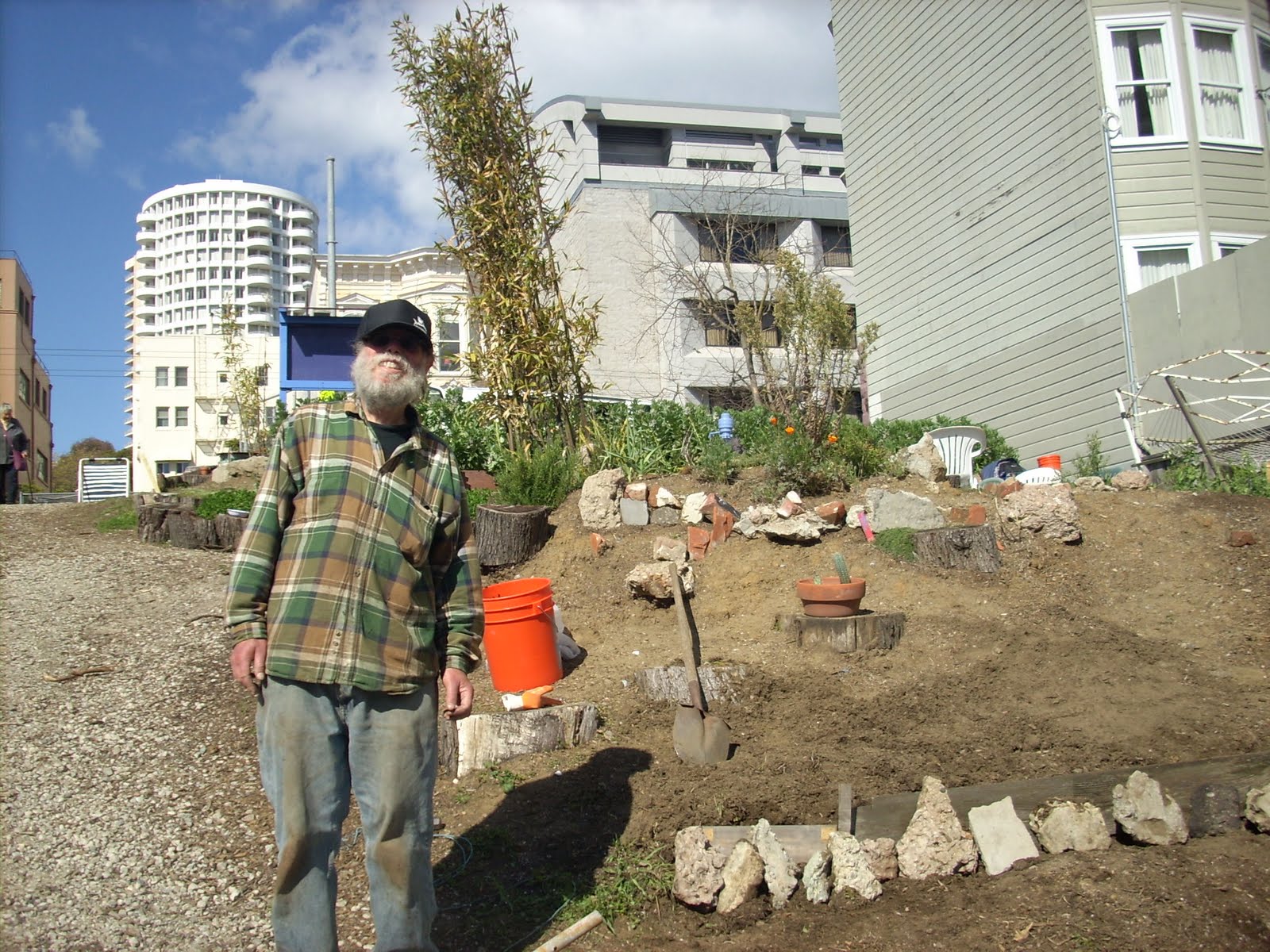
Tree joins students planting in the greenhouse

We thank the Dartmouth group’s work in alleviating hunger, and we always welcome groups and individuals with similar motives to join us at The Free Farm on any of our workdays. Hope to see you real soon!

Public Service Announcements:

March is National Nutrition Month: “Eat Right with Color”
Eating a variety of foods supplies different nutrients, so to maximize the nutritional value of each meal, include healthful choices in a wide range of colors.
http://www.openhand.org/2011/03/01/happy-national-nutrition-month/
Sun., Mar. 20, 2011: Meatout
Meatout is an international observance helping individuals evolve to a wholesome, compassionate diet of fruits, vegetables, whole grains. The purpose is to expose the public to the joys and benefits of a plant-based diet. "Kicking the meat habit" holds lasting benefits for consumer health, world hunger, resource conservation, environmental quality, and animal protection. More information at http://www.meatout.org/ & http://www.sfvs.org/

Meatless Monday is a non-profit initiative of The Monday Campaigns, in association with the Johns Hopkins’ Bloomberg School of Public Health. Presidents Wilson, Truman and Roosevelt galvanized the nation with voluntary meatless days during both world wars. By cutting out meat once a week, we can improve our health, reduce our carbon footprint and lead the world in the race to reduce climate change.
http://www.meatlessmonday.com/& http://www.sfvs.org/

Tues., Mar. 22, 2011 at 6-9 pm: Water Matters discussion & party
Project One, 251 Rhode Island St., San Francisco
March 22 is World Water Day. Participate in the conversation and party afterwards at the launch of the new book, Water Matters: Why We Need to Act Now to Save Our Most Critical Resource. Join Water Matters editor and AlterNet staffer Tara Lohan in conversation with leading environmental thinkers including: Water Matters contributor Wenonah Hauter, executive director of Food & Water Watch; Michael Brune, executive director of the Sierra Club; Debbie Davis, policy director for the Environmental Justice Coalition for Water; Jacques Leslie, Water Matters contributor and author of Deep Water: The Epic Struggle Over Dams, Displaced People and the Environment; Francesca Vietor, president of the San Francisco Public Utilities Commission and interim program officer for the Environment at the San Francisco Foundation.
Conversation will run from 6:15pm-7pm and then we'll have time to eat, drink and be merry. Expect delicious light food and a cash bar. RSVP by emailing RSVP@alternet.org
http://watermatters.eventbrite.com/


Wed., Mar. 23, 2011 at 6-7:30 pm: Climate change discussion
San Francisco Public Library, 100 Larkin St., (at Grove), San Francisco
Healy Hamilton, the director of the Center for Applied Biodiversity Informatics at the California Academy of Sciences talks with freelance science journalist Mark Hertsgaard about his latest book titled Hot: The Next 50 Years on Earth. In this conversation you will hear about how climate change is altering weather patterns around the world and how it will impact localized weather related events in unique and unexpected ways. Hertsgaard's book takes an optimistic look at how we can adapt to the altered state of life that comes with climatic changes. Learn about how plants and animals, including humans, are already beginning to shift in response to the changing world around them.
http://www.sfpl.org/index.php?pg=1003127201

Saturday, March 12, 2011

Spring forward: The world will need more farmers!

In the past week, The NY Times published articles that pointed to the demand for manual labor that can’t be automated by technology or outsourced overseas. After noting how technological progress is actually reducing the demand for highly educated workers, economist Paul Krugman challenged our obsession with college education—“which may be no more than tickets to jobs that don’t exist or don’t pay middle-class wages.” (http://www.nytimes.com/2011/03/07/opinion/07krugman.html). In response to the UN’s March 8, 2011 report, “Agro-ecology and the Right to Food,” Mark Bittman observed: “Agro-ecology and related methods are going to require resources too, but they’re more in the form of labor, both intellectual — much research remains to be done — and physical: the world will need more farmers, and quite possibly less mechanization.” (http://opinionator.blogs.nytimes.com/2011/03/08/sustainable-farming/)
We all need to eat plants so growing plants is an essential life skill, which you can learn tuition-free and hands-on at The Free Farm! In From Telling to Teaching, Joye A. Norris, Ed.D., sets out the following 7 elements for effective learning, which you can personally experience here: engaging in dialogue; positive and safe environment so people feel free to speak; activating prior learning; variety of approaches (visual, kinesthetic, auditory) so people can show how smart they are; open questions to inspire deeper, more reflective thinking; partner interactions to test ideas, energize room; and reinforcing learning. Educator Edgar Dale noted the most memorable learning comes from doing the real thing and talking about it.

Tree's task list

Today I completed my 40 hours of community service requirement toward my GCETP certificate, but I plan to continue volunteering indefinitely as I’m positively hooked on The Free Farm community (--much like my rent-controlled apartment)! When I started (my initial post at http://thefreefarm.blogspot.com/2011/01/getup-raise-greenhouse-how-to-increase.html), I had no experience blogging, identifying bolted lettuce, constructing a greenhouse, managing a farm stand, etc. And I have so much more to learn! Organic farming involves lots of trial and error as we try to work with, rather than control, nature—which is increasingly unpredictable like our recent weather (sun, rain, snow).

My GCETP classmates weren’t at the Farm today, but my public health nutrition classmate Marlo volunteered today. After completing our clinical nutrition class, we’ve been fascinated at how food truly is medicine in the prevention and treatment of chronic diseases (cardiovascular, GERD, inflammatory bowel, diabetes, liver, kidney, cancer, HIV/AIDS, etc.). The most nutrient-dense food is grown in soil built with organic matter, free from harmful chemicals.

As more people make the connection between food and health (Marlo and I are nutrition educators!), they will want to eat more SLOW (Seasonal, Local, Organic, Whole) food—so there will be increasing demand for food grown locally. And, farming is best done when you can share in the manual work within a community, building biceps and people-to-people ties.

One pleasant surprise was learning that Jordan was the same fellow whom I had an email correspondence last summer when we were both working at Women’s Initiative for Self-Employment—Jordan was a Microenterprise Fellow while I was transitioning to my virtual office. Today I learned that Jordan makes a savory potato, quinoa and split pea salad—something you must experience with all your senses!

Remember to spring forward at 2 a.m. on Sunday!
Wake up refreshed to some great music http://www.youtube.com/watch?v=c_mrUvixxkY
"Early to bed, and early to rise, makes a man healthy, wealthy and wise.” Benjamin Franklin

Public Service Announcement:
Thurs., Mar. 17, 2011 at 6 pm: Fair Farm Bill kickoff
25 Stillman St, Ste 200, San Francisco, CA 94107
In the face of budget cuts to local food programs, now is the time to build powerful support for healthy food and sustainable agriculture in California. We all have a stake in increasing access to healthy food and supporting small and mid-sized farmers.
RSVP at https://salsa.democracyinaction.org/o/1185/p/salsa/event/common/public/?event_KEY=66940
Join us at The Free Farm next Saturday because the world needs more organic farmers!

Before the harvest

Fixing plumbing

Lauren continues construction of toolshed
Marlo harvests lettuce
Stained glass adds elegance to greenhouse
Lavender & mushrooms

Transplanting cucumber seedlings

Avocado tree sprouts from split pit

Marlo records weighed produce Pancho holds up his bamboo cup creation
Neighborhood council member joins gratitude circle between Marlo & Tree

23 volunteers showed up for lunch

Chef Jordan created spiced potato, quinoa & split pea salad

Ricardo & Marlo wear T-shirts to make statements

Neighborhood regulars arrive to select from 30 lbs of harvested produce: chard, kale, mixed lettuce, fava beans, snap peas & lemons
Mimicking rainwater
Installing window

Gray Line tour makes stop in front of The Free Farm!

Sunday, March 6, 2011

Get up, Stand up (tree collards)

Hey Everyone! It is Sophie again, one of the Garden for the Environment GetUp! Graduates volunteering at the Free Farm.

This Saturday, twenty four volunteers came out to the Free Farm. Along with the regular job of harvesting, volunteers worked on planting peas and kale as well as building a terrace with sunchokes. When my mom and I arrived, there was already an abundance of tree collards, swiss chard, kale and lettuce waiting to be weighed for the day’s farm stand. In the past couple of weeks, tree collards have been a regular appearance at the Free Farm.

Tree collards are a pretty amazing crop. They grow on long stalk-like trunks and extend out in an alternating pattern. Tree collards are another one of my favorite plants. They look pretty cool when they are on their stalks and when I was washing them this Saturday I saw an even cooler view of them. While placing the tree collards in the buckets of water, I saw them illuminate and almost glow in the water. Needless to say, I was pretty amazed. I later realized that the “lighting up” affect is probably just the water running off the leaves leather-like exterior, but they are still really pretty.

While I was washing the crops and marveling at the tree collards, other volunteers were planting peas and kale. Like I said in my last blog, watching plants grow from little seedlings or starters to full grown plants ready to be harvested is pretty awesome. I look forward to seeing these pea and kale plants grow more and more every Saturday

This week, my mom and I were in charge of preparing lunch. While she handled the harder stuff (brown rice and tuscan kale, roasted sweet potatoes and beets, and a little orange-ginger sauce), I decided that I would make a dessert. After using WAY too much baking soda in my apple cobbler, I decided to make some vegan oatmeal cookies. And despite the apple cobbler disaster, I think they turned out pretty well, if I may say so myself :). Here is the recipe:

1/2 cup whole wheat pastry flour
1/2 cup quick-cooking rolled oats (not instant)
1/4 teaspoon non-aluminum baking powder (such as Rumford)
1/4 teaspoon ground cinnamon
1/4 cup light molasses or sorghum syrup (I substituted maple syrup for the molasses)
2 tablespoons canola oil
1 tablespoon water
3/4 teaspoon vanilla extract
1/4 cup walnuts, coarsely chopped
1/4 cup raisins

Thanks for reading! Until next weekend,
Sophie


Listen to Bob Marley's “Get up, Stand Up” at http://www.youtube.com/v/_wHHLdD8UPI

Sunday, February 27, 2011

This ground on which the seed of love is sown

Getup classmates Sophie and Lynn share their experiences during yesterday’s workday:

Sophie: Container gardening & inspiring visitors to grow their own!

Hello blog-readers! It's Sophie again, one of the Garden for The Environment GetUp! graduates volunteering at the Free Farm.

This not-so-snowy Saturday a brave 16 volunteers came out to the Free Farm workday hosted by Tree. When we arrived Tree ushered us into the newly finished greenhouse where he showed us a list of the possible jobs for the day. Excited to work in the container garden, I chose to fill the newly finished pots (made by Lowell High School ceramics students) with a combination of potting soil and compost.

After finishing filling each of the pots (and taking a break to enjoy a delicious lunch made by Alena), I walked down to the greenhouse to see what I could plant. Tree directed me to a huge tray of little radish plants that were ready to be planted along with a smaller tray of lettuce plants. I transplanted a mixture of each of these two plants into the three pots, spacing them each 2 finger widths apart.

Transplanting has become one of my favorite parts of gardening. Although it is pretty simple, I love being able to take plants that are so small and transfer them to a new home, where they will be watered and tended to until they are ready to be devoured. Seeing the crops that you initially planted (or transplanted) as tiny seeds (or small plants) grow to be healthy crops ready for consumption is so rewarding.

Sophie plants lettuce & radish in ceramic pots made by Stanley's Lowell High students

Even more rewarding is working at the Farm Stand where neighbors come and take produce for their week. As I volunteer at the Free Farm longer, I begin to recognize Farm Stand regulars. Every week, a woman from the neighboring apartment building comes by and tells us about her week. This week she shared with us her attempts at trying to grow her own rosemary. This exemplifies the mission of the Free Farm, getting regular customers or even someone who is just walking by to see the farm and be inspired to grow something of their own. The newly built greenhouse is advancing this mission by housing starters that will eventually be given away to the neighborhood residents.

Until next week,
Sophie


Lynn: Jack hammering cement and planting Yacón

On Saturday many volunteers come to spend their morning outside. The compost was steaming, favas were happily in flower, plumbing was implemented, collards and kale were harvested, I dug a terrace for the first time, and a handful of people went home with free veggies for the day. Unfortunately, a dead pigeon found itself on the Free Farm, so we gave it a proper burial.

Aaron and I were a few of the earlier volunteers to arrive. We were listening to Tree’s instructions of how and where to plant the Yacón before John came in to steal Aaron for help with jack hammering the cement away. Plumbing was more important on this day. It was his first time using a jackhammer and, though hesitant at first, he found it to be a thrilling experience.
John watches Aaron jackhammering cement Lynn planting Yacón
I continued on with planting the Yacón as Tree tended to other new coming volunteers seeking to help out. Carmen came by and harvested collards. John buried the pigeon, I gave a short eulogy. Other volunteers helped out with the greenhouse, watered, planted new seeds, and worked on new plumbing. Stanley brought two new clay pots made by her lovely students.

After a lovely morning of work, it was soon noontime, lunch to be served. The day’s menu: buttered white and wild rice with roasted butternut squash, collards, and herbs. Banana pudding bread, freshly baked bread, and peanut butter on the side. We gathered together in our typical Gratitude Circle. We held hands as Evan lead with a Grateful Dead lyric, “Last leaf fallen bare earth where green was born.” He thanked everyone for their time here, John lead a group breath, and we were ready to eat.

Play Grateful Dead's "New Potato Caboose" at http://www.youtube.com/v/BDPdhNOujIE&autoplay=1

In the afternoon, a sink was installed, people went home with freshly picked local organic produce, I dug a terrace with Jordan’s help, weeds were pulled, and a vegetable bed layout was designed for one of the greenhouses.

Aaron and I went home feeling like a morning was well spent. It was incredibly rewarding to work out in beautiful weather with good friendly people, and share a delicious meal together.

Next week, I’ll be planting those Sunchokes on the new terrace. We’ll see how theYacón is doing, and perhaps the compost will be ready for turning. I wonder what new seedlings will have sprouted? New work done on the greenhouses? I wonder what delicious meal our volunteers will have made for us next week? What new friend I’ll make? Come join us to find out!
Lynn

Saturday, February 26, 2011

A Tree. A Rock. A Cloud.

The weather forecast was snow, but we ended up with “sunny skies sweeping (most of) the clouds away!”

Earlier in the day, I alluded to Carson McCullers’ short story, A Tree. A Rock. A Cloud., as inspiration for a blog post if I could get a photo opportunity. Later in the day, after Getup classmate Lynn built a fortress of rocks, Tree responded in his usual good-natured manner when I asked him to pose next to a rock with a cloud above.

A Tree. A Rock. A Cloud. was required reading in my 8th grade English class. (You can read it online at http://www.osu.cz/ffi/kaa/dokumenty/kolar/tree_rock_cloud.htm. Tree mentioned that he liked the hyperlinks in my last post so I’ll just include a few in today’s post.) In this story, a man strikes up a conversation with a 12-year-old boy (my age in the 8th grade). Married to a woman who made him feel complete, the man was devastated when his wife left him after a year of marriage. Five years after his loss, the man figured out the “science of love”: how to progress from love of inanimate subjects (hence the title: a tree, a rock, a cloud) to love of a woman (complex human being). The man said he mastered this science so “I can love anything.” Yet, when the boy asks whether the man has fallen in love with a woman again, the man says he is cautious and not ready for the last step in his science.

Like the 12-year-old boy, all I could do was ask more questions: Was the man like Simon & Garfunkel’s "I Am a Rock" (“If I never loved I never would have cried. I am a rock, I am an island. . . And a rock feels no pain; And an island never cries.” View and listen to http://www.youtube.com/watch?v=PKY-smJ6aBQ) What kind of love was this man talking about? The ancient Greeks had four words for love: storge (family affection), philia (friendship), eros (passionate love), and agape (universal love). By the way, what was my English teacher thinking in assigning this short story to inexperienced 8th graders?

A Tree. Today, I wonder: Maybe the man’s science of love theory is valid—that men should fall in love beginning with a tree? I’m reminded of Shel Silverstein’s book, The Giving Tree, about a selfless tree who loved a boy so much that she gave him everything he asked for. But when the boy grows older, he doesn’t reciprocate; instead, the greedy boy keeps taking from the tree and ultimately ends up cutting down the tree so he can build a sailboat. When the boy grows into an old man, the tree stump says she has nothing left to give. But the boy-man explains, "I do not need much now, just a quiet place to sit and rest." The giving tree invites the boy-man to sit down and rest, saying, "Well, an old stump is good for sitting and resting.” The boy did just that, and the tree was happy. The end. But I didn’t feel this ending was happily ever after. Instead, I felt grief: Did the boy-man ever really love the giving tree, or was he just exploiting the tree’s resources? What’s the boy-man’s relationship with other creations, including human creatures like his wife and children?

(Listen to “Cruel to be Kind” at http://www.youtube.com/watch?v=b0l3QWUXVho&feature: “You say your love is bonafide, but that don't coincide with the things that you do. . . Well, I do my best to understand dear, but you still mystify, and I wanna know why. I pick myself up off the ground to have you knock me back down again and again . . .)

A Rock. A tree’s roots are covered in soil, which is made of rock. John Jeavons, author of How to Grow More Vegetables Than You Ever Thought Possible on Less Land Than You Can Imagine, believes farming takes more than it gives. Therefore, he recommends that farmers devote at least 60% of planting space to growing crops as compost ingredients to build soil.

A Cloud. Clouds bring rainwater, which is free and an ideal source of water for growing plants.

Organic farming is labor of love intensive, requiring special attention and care to everything in the environment—a tree, a rock, a cloud—that affects the growth and well-being of all creation. The Free Farm is a great place to practice “the science of love”—being generous to both our natural and human communities. So come outside and farm with us!
Tree's to-do list
Jordan harvests kale
John picks up dead pigeon
My shadow taking photo of pigeon's grave; bye bye birdie
Tree goes over to-do list with Sophie, Stanley & Emily
Emily puts up clothesline; check out Emily's blog about container gardening at http://thymeandreason.blogspot.com/
Rinsing harvested collards
Chef Alena brought wild rice with butternut squash & cranberries
Multi-talented Ricardo, musician & gardener, is also a baker who brought banana bread
Ricardo’s yummy banana bread recipe:
2 cups flour
1 1/2 tsp baking soda
1/2 tsp salt
1 cup sugar
1/4 cup oil
4 ripe bananas, mashed
1/4 cup water
1 tsp vanilla
Pre-heat oven to 350 degrees. Lightly grease a 9-inch square baking pan. In a small bowl, combine the flour, baking soda and salt. In a separate large bowl, whisk together the sugar and oil, then add bananas. Add water and vanilla, stirring to combine.
Add the flour mixture, stirring just until wet.
Bake for 45 to 50 minutes, or until a toothpick inserted in the middle comes out clean.
Evan says grace before lunch
Stanley's painted chalkboard-style sign attracted more visitors to The Free Farm!
Emily harvests while Hannah & Alena continue construction of 2nd greenhouse
Snail gets suntan
Stanley touches up "The Free Farm Come Grow with Us" sign
Lynn built this fortress of rocks
Vegetarian neighbor Pia visits The Free Farm Stand