Sunday, June 10, 2012

Urban agriculture for everyone!

This posting highlights a couple of cool gardens near The Free Farm that meet people where they are as we continue to increase our spiritual footprint (http://thefreefarm.blogspot.com/2011/09/our-spiritual-footprint.html).  

St. Mark’s garden for seniors in the neighborhood
At the invitation of St. Mark’s Martin Luther senior housing community, Free Farmers Margaret, Page and Kris volunteered to help with their garden last week. According to Margaret: “The St. Mark’s garden has a long history with The Free Farm. Lauren Anderson and Case Garver built the raised beds, planted, and I think put in the watering system. The seniors asked us to help re-plant, which was really wonderful.”  Margaret also sent these cool photos:
Free Farmers Margaret and Kris with Tony and Jeri at their garden
Before picture of Martin Luther garden
 
Page and Kris at work in garden
Broccoli & herbs
 
Herbs bed
Greens & herbs
Strawberries
Martin Luther roof view after re-planting

Antioxidant-rich plants for vision health
Project Open Hand strawberry spinach salad: spinach Greens + red Onions + Mushrooms + strawBerries; add Beans + Seeds for GOMBBS! I’ll post anything relating to cancer-preventing GOMBBS if this brings more visitors to this blog to learn about The Free Farm :-)

Studies show that eating antioxidant-rich leafy green veggies and strawberries can reduce the risk of age-related macular degeneration, a common cause of vision loss in persons age 50+ (http://www.ahaf.org/macular/livingwith/healthyliving.html).  People who lose their vision can still enjoy gardening . . .

Please Touch Community Garden
In 2010, artist Gk Callahan partnered with LightHouse for the Blind and Visually Impaired (http://lighthouse-sf.org/) to transform an abandoned City lot into a multi-use community space that would be accessible to people of all abilities. Named Please Touch Community Garden (PTCG) (http://pleasetouchgarden.tumblr.com/), it’s located at 165 Grove Street near Van Ness, in the shadow of City Hall.  But you enter through quiet, pedestrian-friendly Lech Walesa Alley just across from LightHouse building, which makes it very convenient for LightHouse community to access the garden!

Like The Free Farm, PTCG is an all-volunteer effort with help from nearby LightHouse, Hayes Valley Farm and SF Permaculture Guild. For now, it’s open Wednesdays 11-5. When I was able to arrange my schedule to check out this treasure, I found Gk and Rob tending the garden, which they’ve made into such an inviting space with several visitors dropping in.

Like SF Botanical Garden’s Fragrance Garden, most gardens for the blind seem to focus on scent (http://www.perkins.org/news-events/press/seeing-with-other-senses.html) but PTCG also encourages touch. I like the human-scale of the space (growing space about the size of The Free Farm's labyrinth area), still a work-in-progress: a mix of feeling plants (no spiny cacti), with plans for food production, and tactile sculpture. I felt comfortable walking around with my eyes shut, but I really enjoyed looking. 
Gk escorts a LightHouse visitor. Letters sitting atop white wall read: “TO SEE A WORLD YOU OTHERWISE COULD NOT SEE.”
Andrew and Anna of Native American AIDS Project (http://naap-ca.org/) hand out condoms to Gk as part of their outreach work. The woman with yellow water pitcher dropped in to volunteer while her daughter attends class at LightHouse.
English-Spanish bilingual compost bin in lavender color. PTCG also has worm compost bin. 
Wall garden with touchy plants and beehive. Watchful owl looks in direction of Grove Street.
Potato sprout jars
Michael learns about growing fava beans as cover crop to improve soil from permaculture designer Rob. Michael recognized me from CounterPULSE Eat-In (http://thefreefarm.blogspot.com/2012/01/small-world.html) and dropped off outreach materials for July 15 AIDSWalk (http://aidswalk.net/sanfran).
Rob holds up soil rich in organic matter
I volunteered to “chop and drop” fava plants without beans, but these got tangled in my chopping so I harvested them
Rob shows visitors plans for his wall garden project
Rob is harvesting pigeon poop: “the problem is the solution.”
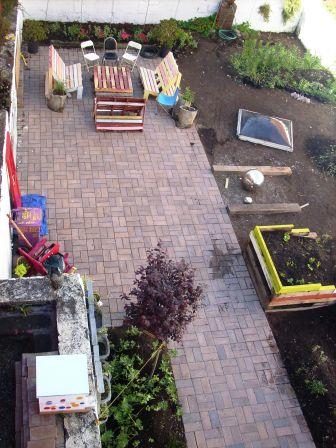
Aerial view of the garden. Table and chairs made from recycled wooden pallets.
Steady stream of visitors enter garden from Lech Walesa alley
Bee drawn into fava mulch

Urban Agri 101
 
Yesterday, Alemany Farmer/filmmaker Antonio taught an Urban Agri 101 workshop at Garden For the Environment. He reviewed resources (http://www.gardenfortheenvironment.org/pages/resources.html), including The Free Farm as a place to volunteer :-), and offered advice on how to be a good volunteer: grow up, show up; follow-through and take responsibility; bring others in; and respect conditions.

As a Getup classmate of Kevin from SF Permaculture Guild, Antonio recommended GFE’s training program (applications for Fall 2012 training at http://www.gardenfortheenvironment.org/pages/gcetp.html) before studying permaculture. He explained that many people think permaculture is about gardening but it’s really about systems design, which can be applied to gardening.

This free workshop was sponsored by SF PUC so we received publications on Water-Wise Gardening, Pest Control and Union of Concerned Scientists’ The Climate-Friendly Gardener. Antonio emphasized drip-irrigation, hydrozones, using mulch to conserve moisture, and selecting low water-use plants.

Antonio also discussed the top 10 things we need to know: 1) soil, 2) compost & fertility, 3) plants/vegetables to grow, 4) trees/shrubs/non-annual vegetables, 5) pest management, 6) garden design & planning, 7) community relations, 8) educating others, 9) animals, and 10) soil toxicity.

Finally, he invited us to attend tomorrow’s Land Use meeting on the new urban agri legislation at City Hall. Details in PSA below.

Public Service Announcements:

Mon., June 11, 2012, 1pm New Urban Agriculture Legislation & Seniors Living in Single Room Occupancy (SRO) Hotels
City Hall, 1 Dr. Carlton B. Goodlett Place, Room 250, SF
The most recent version of the urban agri legislation is available at http://www.sfuaa.org/urban-ag-legislation-2012.html.  Wear green! Also, advocate for improved living conditions in SROs for seniors and people with disabilities; a press conference is scheduled at the Polk St. steps in front of City Hall at noon. This is a follow-up to last November’s hearing described at http://blog.sfgate.com/cityinsider/2011/11/21/supervisors-hear-litany-of-horrors-for-seniors-at-sro-hotels/). http://www.sfbos.org/Modules/ShowDocument.aspx?documentid=41916

Tues., June 12, 2012, 7:30 pm Applying Food Movement Tactics To The Utopian Future
Luggage Store Gallery, 1007 Market St., near 6th St., SF 94103
Join Antonio Roman-Alcala and Amy Franceschini for an evening that will start with a review of recent/current tactics employed by those seeking a “good food” system, at multiple scales and in many venues. Using this outline as a base, we will lead a discussion on our options for applying successful strategies and tactics from the food movement to other realms of societal transformation. Specifically, we will ask participants to envision how these forms can actualize our “right to the city”. http://streetopiasf.com/2012/04/21/full-calendar-of-streetopia-events/

Wed., June 13, 2012, 6-8 pm Breaking Through Concrete: A Virtual Tour of Urban Farms
Port Commission Hearing Room, 2nd Floor, Ferry Building, Embarcadero & Market St., SF
Join CUESA for a virtual tour of successful urban farms from around the country with brothers David and Michael Hanson, author and photographer for the book, Breaking Through Concrete. http://www.cuesa.org/events/2012/breaking-through-concrete

Sat., June 16, 2012, 4-7 pm GFE'S 2012 SUMMER SOLSTICE PARTY
Garden for the Environment, 7th Ave at Lawton Street, SF
Celebrate the Summer Solstice with GFE in the garden! Join us for some wood fired pizza, beverages, old-time music and a gardeners potluck to start the summer! Bring your picnic blanket and a potluck dish to share. We will be hanging out, eating amazing pizza and enjoying the beauty and bounty of the garden. http://www.gardenfortheenvironment.org/

Saturday, June 9, 2012

Streetopia for the People

"Among other things, you'll find that you're not the first person who was ever confused and frightened and even sickened by human behavior. You're by no means alone on that score, you'll be excited and stimulated to know. Many, many men have been just as troubled morally and spiritually as you are right now. Happily, some of them kept records of their troubles. You'll learn from them - if you want to. Just as someday, if you have something to offer, someone will learn something from you. It's a beautiful reciprocal arrangement. And it isn't education. It's history. It's poetry."
- Mr. Antolini’s advice to his student Holden Caulfield in The Catcher in the Rye, by J.D. Salinger

It seems so fitting that The Free Farm’s neighbor Tenderloin is hosting Streetopia (http://streetopiasf.com/) because it’s home to so many health and social services organizations with compassionate staff and volunteers who seek to improve community conditions closer to utopia. My own decision to volunteer at The Free Farm was partly inspired by my Getup training at Garden For the Environment (http://www.gardenfortheenvironment.org/pages/support.html), where we put together the weekly CSA box of organic produce for Food Runners to deliver to Larkin Street Youth (http://www.larkinstreetyouth.org/) for homeless youth in the Tenderloin.

People’s history of the Tenderloin
 
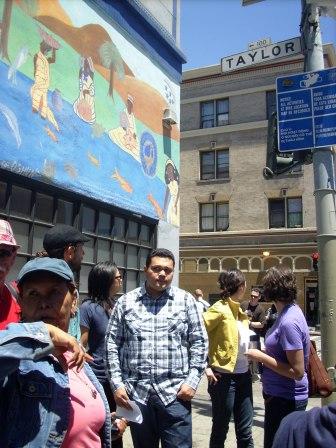
As a fan of Howard Zinn’s A People’s History of the United States, I eagerly joined Streetopia’s “Every Building has a Story” Towards a People’s History of the Tenderloin Walking Tour organized by James Tracy (http://www.jamestracywords.com/), a very compassionate and informed housing activist. As a youth, James visited the Tenderloin a lot when he came to visit his uncle who lived at Polk and Eddy; and later, he stayed with his uncle a lot as his in-home support service worker. James said he spent a lot of time walking around with his uncle, a sailor and member of the Sailors Union of the Pacific, who shared stories of SF.

About a dozen of us met at Luggage Store Gallery to meet our Tenderloin neighbors and learn about their struggles/successes to create their own utopia. To make this a real People’s History, James invited us to chime in with our own oral histories and recollections—and several in the group played major roles in the history of making the Tenderloin a better place to live. Also noteworthy is the prominence of gardens in people’s visions of utopia!
James points out San Cristina Hotel, 1000 Market St., one of 52 Safe Haven Program (http://centralcitysafehavens.org/about/) locations in the Tenderloin and SoMa, which provides “15 minutes of shelter and a phone call” to anyone in distress. Locations are identified by a green and yellow sign in seven languages, designed by a community artist who lives in San Cristina. The program was started in 2007 by Tenderloin residents who wanted to make their neighborhoods safer by relying on each other, instead of the police.
Compton Cafeteria (http://en.wikipedia.org/wiki/Compton%27s_Cafeteria_riot), 101 Taylor at Turk, was the site of one of the first recorded transgender riots against police harassment in U.S. history in August 1966, which preceded the 1969 Stonewall Riots in NYC.
A woman in our tour group said that she was one of the original “screaming queens” as a 15-year-old boy.
Empress Hotel, 144 Eddy, nearly lost its 88 residential rooms when a new owner attempted to convert rooms for tourists. In 2003, Tenderloin Housing Clinic and Coalition on Homelessness intervened to obtain the Planning Department’s ruling of Empress’ residential status. Today the Empress provides housing for the homeless through the City’s Department of Public Health’s Direct Access to Housing program (http://www.sfdph.org/dph/comupg/oprograms/DAH/default.asp).
Ambassador Hotel (http://en.wikipedia.org/wiki/Ambassador_Hotel_San_Francisco), 55 Mason St., was a former slum hotel, which cleaned up in the mid-1990s after this woman made a video short of its dilapidated conditions (no community kitchen, residents relied on hot plates and meals from Project Open Hand http://www.openhand.org/join-us/volunteer/; mold-infested showers; backed up toilets, etc.). The activities of community organizers resulted in 55% rent reduction. In 2000, nonprofit Tenderloin Neighborhood Development Corporation (TNDC) acquired the property to serve as low-income housing.  
Alexander Hotel (http://www.tndc.org/property/alexander-residence-230-eddy-street/), 230 Eddy, provided affordable housing as a HUD-insured Section 8 senior building. But President Clinton’s administration allowed private landlords to get out of Section 8 and go to market, if they prepaid their mortgages. As a result of tenant organizing, the City intervened to preserve Alexander for low-income people. In December 2000, TNDC and now defunct SFRA purchased Alexander to prevent the displacement of the building’s tenants and ensure long-term affordability. 
This Safe Passage (http://www.nom-tlcbd.org/index.php/services/safe-passage), marked by yellow brick road pattern on this Leavenworth block with Head Start Program, is a series of safe routes for youth throughout the neighborhood intended to ensure a secure walk home from school and to/from extracurricular afternoon activities. These routes are closely monitored by volunteers, neighborhood groups and SFPD to keep them free from crime and negative activity.
Senator Hotel (http://www.chp-sf.org/pgs/senator.html), 519 Ellis St., was where the American Indian Movement occupiers stayed for one night after they were evicted by federal marshals following the 18-month occupation at Alcatraz that ended in June 1971. In 1991, Community Housing Partnership acquired the building to house formerly homeless individuals and families in response to a permanent housing campaign led by Coalition on Homelessness and Council of Community Housing Organizations.
We take a break to eat at Free Café in Tenderloin National Forest.

Hastings College of Law, 200 McAllister St., was the site of demonstrations by a coalition of community groups in 2002 to protest Hastings’ construction plans for a new parking garage where two residential hotels destroyed in the 1989 earthquake once stood. While the parking garage was ultimately built, the action forced Hastings to fund 172 units of replacement housing at 220 Golden Gate Ave.

At this point, I’m going to interject to share my own recollection of teaching first-time juvenile offenders from Youth Guidance Center at the Hastings campus. At the invitation of a professor, I agreed to teach Street Law Project’s pilot program focused on criminal "justice" on Saturday mornings. The first meeting was rough because the sulking teens didn’t have breakfast and claimed that I was too strict when I required respectful manners like saying please, thank you and no profanity! So like the Black Panthers before me, I brought in breakfast and they opened up so we got into deep discussions about channeling their anger and frustration over injustice into positive actions to benefit everyone. I was so proud of my students when they formed a band and started getting offers for gigs—they were so good that they told me that they would give up selling illegal drugs! As they were still minors, I connected them with an entertainment lawyer to represent them on pro bono basis. 

Before I began farming on Saturdays, I volunteered at Tax-Aid every spring season to prepare income tax returns at Glide (and other sites) for low-income residents who are usually eligible for the Earned Income Tax Credit (EITC). Because my colleagues and I worked for the 1% (i.e., many trust fund clients who didn’t have to work for a living, so they carried on lives of leisure going to retreats, sometimes to find a purpose in life or to detox), it was really refreshing to work with the other end of the wealth spectrum to maximize tax credits/deductions so they could get back some of their hard-earned money. Many came with multiple W-2 forms, and some were undocumented taxpayers using TIN or fake SSN so they didn’t qualify for EITC—but being a taxpayer may help for immigration amnesty. Some came with their children who helped with translation. I learned about how they came to the U.S. to escape persecution in their native lands only to be exploited in our land of opportunity—often because they weren’t fluent in English so they wanted to use any free time available to learn English. (And I thought my trust fund clients could find a purpose by doing meaningful work like volunteering to teach English to immigrants struggling with the language.)
Tenderloin People’s Garden (http://www.tndc.org/our-services/community-garden/) was built over a concrete corner plot on Larkin & McAllister, as an all-volunteer community garden in a neighborhood regarded as a food desert that lacks affordable, healthy food options. Everything grown in this garden is communal property, and neighbors get together to harvest and share in the bounty.
This resident gardener mentioned plans to build a high-tech vertical garden against the wall of the Civic Center Power House.
Succulent circle
Federal Office Building, 50 United Nations Plaza, was where two HIV-positive gay men chained themselves to its doors to protest the U.S. government’s inaction in face of the deadly AIDS epidemic in October 1985. Soon, they were joined by volunteers who began the decade-long ARC (Aids Related Complex)/AIDS Vigil demonstration.

This site reminds me of the Power of 504 (http://www.dredf.org/504site/504home.html), a 26-day sit-in during 1977 by disability activists until they won their demand for adoption of regulations to prohibit disability discrimination. I wasn’t around when this took place but watching this must-see documentary is so inspiring at http://www.youtube.com/watch?v=SyWcCuVta7M!
Trinity Plaza (http://www.trinitymanagement.com/property_detail.cfm?Type=Furnished&PropertyID=27), 8th & Market, has a skyscraper and tower being built behind. In 2002, landlord Angelo Sangiacomo (http://sf.curbed.com/tags/angelo-sangiacomo) announced plans to demolish Trinity Plaza, potentially displacing 360 working-class households. As a result of community organizing, all residents were offered new units and lifetime leases in the new luxury towers.

James concluded our walking tour with his opportunity or displacement commentary on the impact of the so-called “Twitter Tax Break,” which provides generous tax incentives for new and expanding businesses in mid-Market area. This legislation brought in an affordable bike repair shop, restaurants, other small businesses and a new arts district coming in to fill vacant storefronts and create new jobs, thus making Market Street a safer and more desirable place to walk. However, James also noted that the arrival of new tech companies and gentrification pressures in the area have contributed to a 45% jump in rents in Tenderloin’s private, non-subsidized buildings. He mentioned that rent for a new, one-bedroom unit in the Tenderloin is about $1,400.

People gotta eat
From the back of a car parked in the heart of the Tenderloin, Mother Teresa group freely handed out fish fillet, bun, mac and cheese, and watermelon on these plates to anyone on the street. Where are veggies?
I paid $3.50 for my favorite banh mi, or marinated tofu Saigon sandwich with shredded carrots, radish and cilantro tucked in French roll.  This represents about 75% of the average $4.72 daily food stamp budget.

Views of utopia in mural art
Leavenworth mural with close-up shots of man carrying greens and “we need a garden.”

Windows into the Tenderloin mural by Mona Caron (http://monacaron.com/tenderloin/index.shtml), at Golden Gate & Jones, is so full of life with amusing street level details. Lisa Ruth Elliot of Mobile Bread Bicycle Cart was the mural’s project manager (http://thefreefarm.blogspot.com/2012/05/our-vibrant-neighbor-tenderloin.html).
Goats eat turf for Dept. of Lawn Maintenance.
 
Vegetable garden sign reads, “Put work in, Get food out, Everyone welcome”

The Main Library hosted a screening of the documentary of the mural in the making, "A Brush with the Tenderloin."  Filmmaker Paige Bierma (http://abrushwiththetenderloin.com/) stands between Tenderloin residents Lisa and Indian Joe, who both appear in the mural/film and whose lives were transformed in the process, ending drug abuse and homelessness. Lisa said that she gives back by volunteering at Walden House.

The film begins with Mona asking why commission art in a place where many people are scraping by without basic needs—who can afford art in the Tenderloin? The answer: to bring positive activity and community engagement, which is what happens when Mona does her “slow motion performance art” with the “Greek choir” across the street, 300+ waiting in line for a meal at St. Anthony’s. As Mona interacts with the residents passing by, she’s inspired to insert their images in her murals that combine the present/historical/utopia at the same time. She says her aim is to get people to look up to surroundings and interact, rather than looking to the ground to avoid contact so we get to our destinations more quickly. The mural took longer to complete when a panel was vandalized, so Mona had to repaint and caved into pressure from warnings “don’t put in a cop car.” To avoid graffiti vandalism, she ended up painting a black car, which residents refer as “undercover cop car.” Since then, the mural has not been vandalized as the community respects the mural and keeps an eye out to protect it.

Paige said she filmed 50 hours of footage, but edited video to 23 minutes for a better chance of showing at the festival circuit. I look forward to the DVD with extra footage to learn more about the other characters in the mural utopia and the power of art to inspire transformation.

Like Mr. Antolini said: It’s a beautiful reciprocal arrangement.

Public Service Announcements:

Sun., June 17, 2012, 2-3:30 pm, An Armchair Tenderloin Tour
Latino/Hispanic Community Meeting Room, Main Library, 100 Larkin St. at Grove, SF
Cityguide docent Peter Field will present a slide show on the colorful history of SF's Tenderloin district.

Through June 23, 2012, Streetopia in the Tenderloin
http://streetopiasf.com/Streetopia_calendar.pdf

Sunday, June 3, 2012

Meeting people where they are

Yesterday, my nutrition instructor Lisa (http://www.ccsf.edu/Resources/Faculty/lyamashi/) finally came to visit with her friend James. Our lives have been so busy, which happens when we’re so passionate about improving the quality of people’s lives through healthy eating—there is just no end to our work! (Lisa’s familiar face appeared at http://thefreefarm.blogspot.com/2012/04/grow-plants-cook-plants.html and her RD colleagues visited at http://thefreefarm.blogspot.com/2012/05/friends.html.)

Our volunteer workdays can become routine—planting, harvesting, watering, etc.—so it’s a real treat to have visitors to perk things up. I love to invite friends to meet me at The Free Farm. Goodness, what would I blog about each week without fresh faces to brighten our workdays?!  

While we do provide gloves, these first-time volunteers opted to get their hands dirty while planting more greens. Yay, let’s grow food security! 
Lisa’s friend James is an IT professional/hobby gardener with an organic apple orchard farm in Sebastopol, selling apples to an organic baby food manufacturer. James generously donated to us a shopping bag of sample seed packets ranging from beans to sunflowers. When I asked about the seeds painted in turquoise and pink, James explained that they were treated with fungicide. Unfortunately since we don’t know what kind of fungicide (not just milk, coffee, vegetable oil, detergent, white vinegar, etc. at http://www.abc.net.au/gardening/stories/s1484689.htm; see also http://www.ent.uga.edu/pmh/Hm_Fungicide&Organic.pdf), we’ll err on the side of caution and stick to using seeds of known organic quality. We really do appreciate donations, but we have limited growing space. In fact, Tree is still trying to find space for my second ashitaba (bush grows 4’ wide) . . . so we’d most appreciate donations of land to plant more :-)!
Lunch spread courtesy of Stanley (tabouleh, roasted beets and sweet potatoes), Tree (tossed greens with vinaigrette and calendula petals) and Wandering Veggie (I Am Giving GOMBS salad). Woops, complete protein is missing (other than sprinkle of sesame seeds; http://www.choosemyplate.gov/food-groups/protein-foods.html) but tofu/soybean samples were available at nearby Japantown’s http://soyandtofufest.org/. Lisa’s really cool—an RD who actually likes the taste of food beyond its nutritional content, but I still get self-conscious about meeting nutrition and food safety standards (I passed exam to become Certified Food Safety Manager, thanks to Lisa’s excellent teaching) when I’m around RDs.

Based on Google analytics, this blog’s greatest views appear to be postings that mention GOMBS or GOMBBS (acronym for cancer-preventing Greens+Onions+Mushrooms+Beans+Berries+Seeds, . . . so due to anticipated popular demand, here’s my gluten-free, raw GOMBS salad recipe adapted from Café Gratitude’s Marinated Kale Salad aka I Am Giving:
4 cups kale (Green), chiffonade
1 cup carrots, shredded
1 cup cucumbers, julienne-cut
¼ cup hijiki (presoak 2 hours & drain)
1 cup shiitake Mushrooms, sliced & marinated (¼ cup lemon juice + ¼ cup Bragg’s liquid aminos)
Stir in marinade:
¼ cup e.v.o.o.
¼ cup orange juice
2 Tbsp Bragg’s liquid aminos
2 Tbsp rice vinegar
1 Tbsp sesame oil
Garnish with: chopped green Onions, goji Berries, sesame Seeds
After lunch when Stanley opens farmstand, Lisa recognizes her student Jean who attends nutrition class at Jewish Community Center.

I still remember my first visit to Lisa’s nutrition class at Golden Gate Park Senior Center (GGPSC), where the entrance door had a sign stating the facility was for seniors age 55+, but Lisa made me feel so welcome. She also promoted a safe learning community, so students were free to reveal their personal health issues and then Lisa would kindly suggest dietary changes.

Partly because women outlive men, Lisa’s GGPSC students are mostly women. But unlike the intensity, competition and consciousness-raising that I experienced while attending a women’s college (and I was required to live on-campus with the typical 17-22 age group), the exchanges and bonding among older women were so relaxed and often funny. Sure this was a noncredit class, but I also find most people mellow out from just going through life experiences (“been there, done that”). Since I grew up in a multi-generational household, I really value the diversity from interacting with a wide range of age groups and I’m especially enriched from the wisdom of our elders.
 
When Jean tells me that Lisa’s her teacher, I proudly tell her that Lisa’s also my teacher!
Back to work after lunch
“My family calls me Pancho” arrives with his father visiting from Mexico. 
Stanley and her childhood friend Jaye, who’s visiting from Massachusetts where he has a farm!
Beekeeper Pam with her beeswax candle creations
K offers samples of our first harvest of raspberries!

Growing food security

Tree asked whether Lisa teaches vegetarian diets. The answer is what Lisa often reminds us: You have to meet people where they are—and it’s challenging to restrict foods for someone already with limited food resources to meet nutritional guidelines of a balanced diet (grains + proteins + vegetables + fruits). The reality is that people know they should be eating more vegetables, but many seniors (almost 1 in 3 people age 75 or older in SF lives in poverty) and persons with disabilities are food insecure.

The consequences of food insecurity may mean malnutrition (low-cost, calorie-dense but nutritionally poor food intake of refined salt/sugar/flour--"poor quality vegetarian"), less variety of foods (8 foods are responsible for 90% of food allergies: milk, egg, peanut, tree nuts, fish, shellfish, soy, wheat), chronic disease (obesity, hypertension, diabetes), mental depression, etc.

Since there is a large population of seniors in SF who are unconnected with family and have limited mobility, their issues often fall under the radar. Two weeks ago, District 5 (which includes The Free Farm) Supervisor Christina Olague held a City Hall hearing about the “senior surge” as she was particularly concerned about meeting the needs of her District, which has the City’s highest number of seniors in public housing. (http://www.sfexaminer.com/local/2012/05/parents-exiting-city-droves-leaving-older-relatives-their-own)

Sadly, when the time came for 2-minute comments from the public, many seniors were leaving the chambers so they could have their noontime senior congregate meals. At some senior meal sites, lunch may be the only meal of the day for many seniors. Fortunately, many senior services providers and advocates stepped up to speak on behalf of their clients. Many seniors may qualify but cannot access food distribution programs because they cannot drive, stand in line, carry their food bags up the stairs or hills in their neighborhood. Many find it difficult to go anywhere without assistance and a ride. In addition, even if seniors can access fresh produce, they may lack the facilities for storage and preparation (especially in SROs).
Lolita Kintanar is Director of Senior Services at Canon Kip Senior Center (http://www.ecs-sf.org/programs/cksc.html), which provides meals and other supportive services via Aging and Disability Resource Center (http://ecs-sf.org/programs/adrc.html) stations throughout the City. 
Robin Meese-Cruz is Director of Social Work at Meals on Wheels (http://www.mowsf.org/), which delivers nutritious meals to homebound seniors throughout the City.

At the hearing, one senior in a wheelchair said he wanted to “de-retire” to be productive and pay taxes, not just receive a handout from the government or charitable organizations. According to gerontologists, people perform best when their environment challenges them to test their limits but not overwhelm them. However, if the environmental press is too low, then people suffer sensory deprivation, boredom, learned helplessness, and dependence on others. I thought about how our garden table could meet this senior where he is on his wheelchair. By meeting people where they are and actively engaging them in our gardening activities, our communities would be so much richer.

For other ways to help support food security, see http://thefreefarm.blogspot.com/2011/11/food-justice-hunger-banquet.html

Thanks to all the volunteers and visitors who meet us where we are at The Free Farm to grow and support local food security!