1-800-GLEAN-IT
As a child, my Saturday mornings were devoted to Bible study, which taught me about farming, the livelihood for most Biblical characters—along with carpentry, fishing, wine-making, tax-collecting, etc. I liked learning about the Mosaic law which prohibited farmers from harvesting all produce, allowing the poor to glean leftovers so they would not go hungry or become a burden on their community. I even wanted to make a song out of Ruth, who followed mother-in-law Naomi to Bethlehem, where she gleaned Boaz’ fields: “for where you go, I shall go . . . your people will be my people, and your God my God."

Summer (Ruth & Boaz) by Nicolas Poussin
Now, as an adult, I devote most Saturdays at The Free Farm (on former church ground), where I can hang out with modern-day gleaners from Produce to the People (
http://www.producetothepeople.org/) and Stanford Glean (
http://stanfordglean.blogspot.com/)!
Recently, I spent several days in Pasadena with relatives who have a couple of lemon trees, bearing more fruit than they can care to eat. A lemon tree may bear as many as 3,000 lemons annually, and what should they do with 6,000 lemons per year? I urged them to give away surplus, especially to those in need! For information on how to volunteer or donate food outside of SF, call USDA's "1-800-GLEAN-IT" toll-free hotline; details at
http://www.usda.gov/news/pubs/gleaning/appb.htmAfter doing time in suburban Pasadena, with its inert manicured lawns and indoor air-conditioning, I couldn’t wait to set foot again on The Free Farm! And get my hands in soil and snap these shots of our workday:

Washing harvest

Pancho blogs for Free Farm Stand

Evan & Jenna harvest greens

Alena & Emily harvest in hothouse

Pulling out weed

Adding mulch to labyrinth path

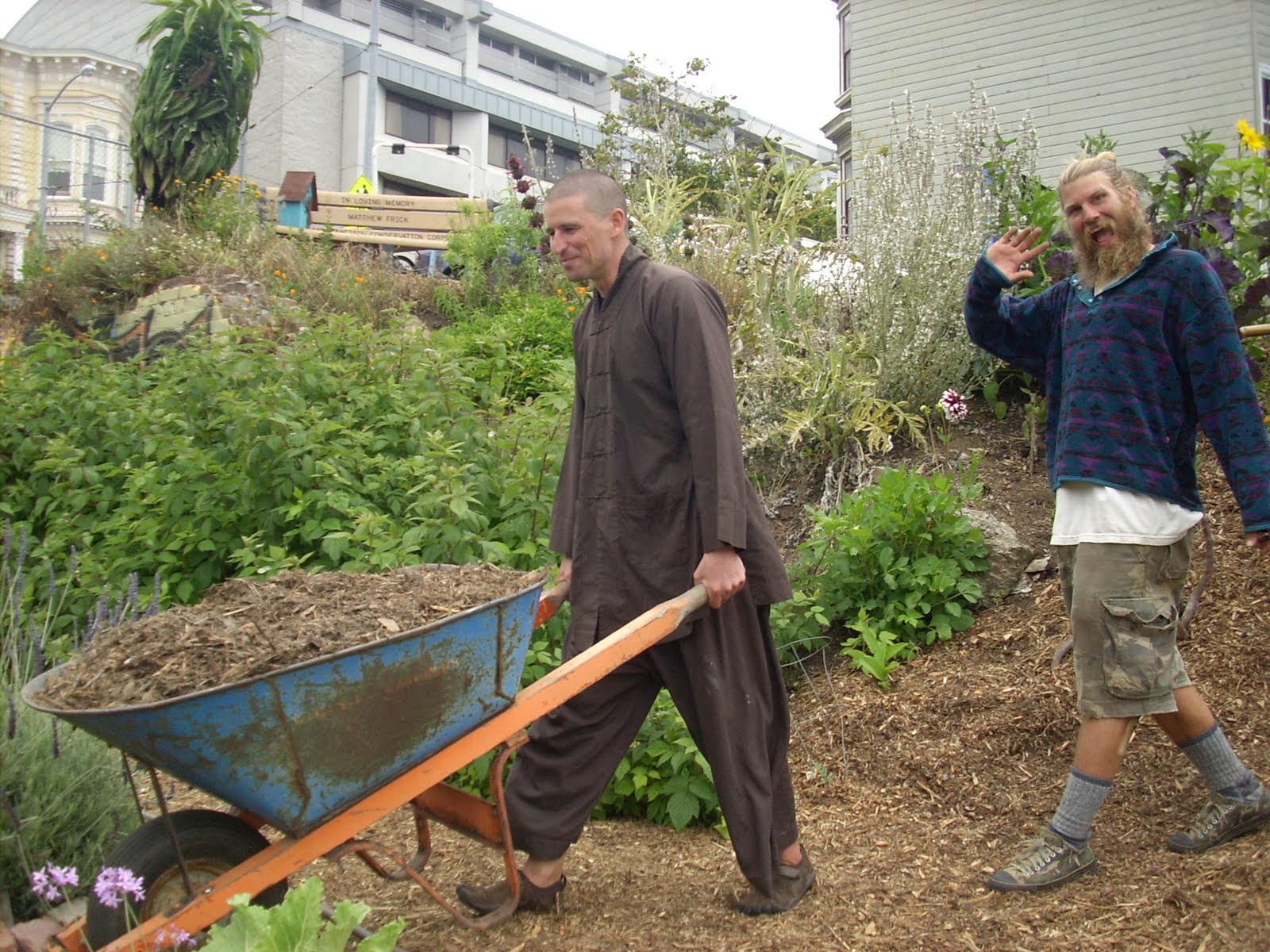
Mike waves hello

Harvested greens

Brent joins Mike, Joyce & Emily for lunch

Strawberries

Artichoke & tree collards

Radishes

Curvy cucumber

Summer squash

Dino kale on scale

Alena with volunteers from Sharethrough; Jenna (in middle) said she learned about The Free Farm workday during Lauren's kombucha-making class at How to Homestead's May event

Lauren brought PttP jam along with Straus dairy & Bi-Rite vegan ice cream!

Bulldog watches over planted bed

Resting in wheel barrow

Rafael enjoys view
Freshly mulched labyrinth

Art said The Free Farm reminds him of his hippie days when he used his van to help SF Diggers glean

Alena brings basil bouquet to workday leader Hannah for farm stand

Jonathan stopped by on his way to teach "Art of Seeding" at SF Public Library; check out
http://www.feeltheearth.org/ for upcoming workshop dates & locations

Watering plants in greenhouse

Bumble bee at work

Nativity scene in summer

Twins Steven & Robert work with PttP through Mayor's Youth Employment & Education Program (MYEEP)

Henry & Ruby hold up tree collard which they plan to transplant in home garden

Robert, Steven & Lauren at farm stand to bring Produce to the People

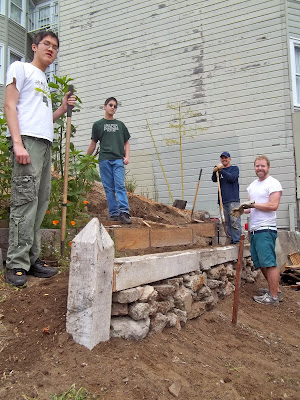
Building bed frame

PttP gleaned these plums from Noe Valley

Brittany, Mike & Pancho
I was in Pasadena, staying with my former hippie aunt and uncle, their daughter (my cousin) and her husband with newborn, to coo over our newest family member. My aunt and uncle had been back-to-the-land types, until my uncle built a 2-story extension to their home over their former garden. Shortly after their wedding, my boomerang cousin and her husband moved into the 2-story extension and installed air-conditioning, dishwasher, electronic entertainment system, etc.
My aunt and uncle are real foodies, willing to drive 3 hours to experience the “Best of.” After my 7-hour shuttle bus ride from SF to LA, I really wasn’t up to spending any more time in a moving vehicle. I insisted on being a locavore so we stayed in Pasadena.
There was indoor air-conditioning everywhere we went in Pasadena! At The Free Farm, it can get very warm in our greenhouse and hothouse, but we do not use air-conditioning. Instead, we open the windows to let air circulate! And we dress in layers – tank top under larger shirt and sweater – peeling down as appropriate to weather conditions.
Life without an electric blanketI thought about the electric blanket conversation between Wally and Andre from
My Dinner with Andre. In one of my favorite films, playwright Wally reunites with an old friend Andre, who dropped out of the theater world at the height of his career many years ago. Andre tells Wally about his experiences while traveling the world and finally experiencing what it truly means to be alive—in contrast to a life that has become habitual so we’re just performing our roles and we don’t really perceive the reality around us. When Andre says he wouldn’t put on an electric blanket, Wally protests saying he would never give up his electric blanket because New York is cold in the winter, we live in a difficult environment so he won’t give up one of the few things that provide relief and comfort—in fact, Wally’s looking for more comfort because the world is very abrasive so he needs to protect himself. Andre’s view is that comfort is dangerous because it separates us from reality so we don’t really see the world, ourselves and how our actions affect other people. Andre says we should be making every moment a prayer or sacrament—whoa, spoken like a permaculturalist! Anyway, I think a non-electric blanket should keep one warm while minimizing EMFs.
While working in corporate America, which included a stint in downtown Los Angeles, I actually lapsed into nature deficit disorder common to urbanites like Woody Allen, who said he was at 2 with nature. To help us become 1 with nature like naturalists, my permie instructor Jay urged us to allow space and time for core routines like sit-spot, journaling, storytelling, wandering without an agenda, etc. Nature is sensitive so we need to be more self-aware, especially our impact on the natural environment, and “walk softly on the earth.”
I always wonder about the privileged who feel they have a right not to know the ramifications of our affluenza (Americans make up 5% of the world’s population yet consume 25% of its resources). It’s so unreal that people choose to be so clueless to avoid responsibility so the status quo remains.
Food, Not Lawns
Most Pasadena homes have manicured lawns. I usually find lawns (especially golf courses) an eyesore because they’re monoculture, high-maintenance using lots of resources (water, pesticides, herbicides, etc.). Lawns sprang about during medieval times to serve the the aristocratic class’ desire for aesthetic and recreational outlets.
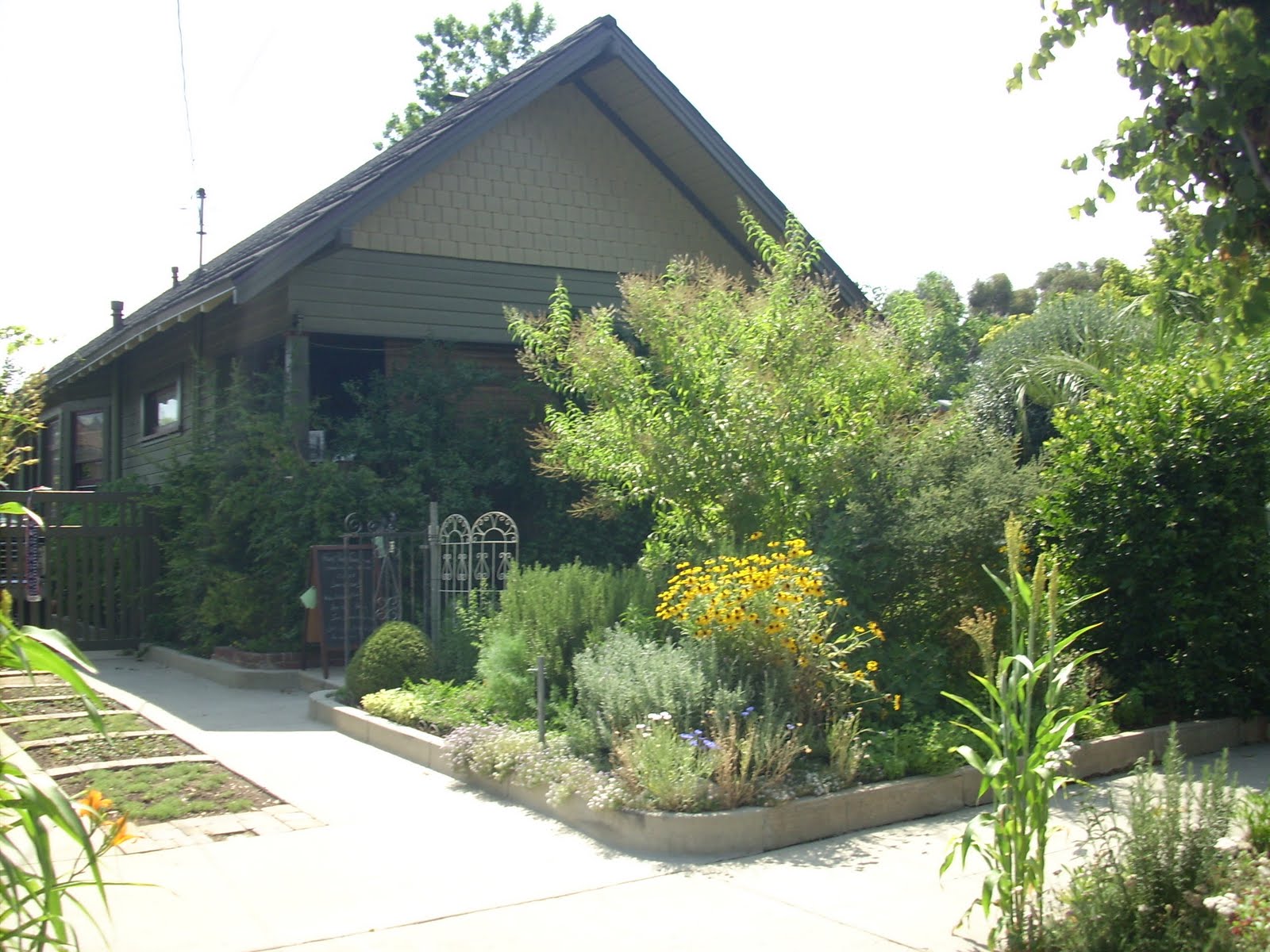
http://www.american-lawns.com/history/history_lawn.htmlOne notable exception to indoor air-conditioning and manicured lawns is the Dervaes family’s Little Homestead in the City ™, established 1985 in Pasadena; online at
http://urbanhomestead.org/. Patriarch Jules Dervaes, calls himself “Founder of the Modern Urban Homesteading ® Movement,” which has been controversial for trademarking this movement. We visited their Front Porch Farm Stand for some creamy raw honey and preserves—payable by cash, check or credit card. I also picked up some free literature; my favorite quote from Jules: “In our society, growing food yourself has become the most radical of acts. It is truly the only effective protest, one that can—and will—overturn the corporate powers that be. By the process of directly working in harmony with nature, we do the one thing most essential to change the world—we change ourselves!”

Though my aunt has been “little old lady from Pasadena” long before the Dervaes family established their homestead, this was her first visit – prompted by yours truly, her locavore niece :-). While the challenging economic times and climate change inspire down-sizing and do-it-yourself initiatives, we felt this urban homestead was lacking: community.
In
http://freefarmstand.org/2011/06/27/the-stand-in-pictures/, Tree posted his sweet letter explaining the goals of the Mission District’s Free Farm Stand because some visitors think it’s a produce give-away program, but it’s more than that. At The Free Farm’s entrance, our goals are clearly stated in a poster board so I think most visitors know what we’re about. But knowing is not the same as doing, which is joining us on our workdays to grow food and community!
During my shuttle bus ride from SF to LA and back, we stopped in Coalinga, which had signs about The Great Delta Toilet Bowl from Water For All. “This land is your land” popped in my head (the way some people sing “99 Bottles of Beer” on road trips) . . . and then again during our workday:
In the squares of the city, under shadow of the steeple
At the relief office, I saw my people
As they stood there hungry, I stood there whistling
This land was made for you and me.
A great high wall there tried to stop me
A great big sign there said private property
But on the other side it didn’t say nothing
That side was made for you and me.
This land is your land, this land is my land
From California to the New York Island
From the Redwood Forest to the Gulf Stream waters
This land was made for you and me.
“This land is your land” lyrics by Woody Guthrie
http://www.youtube.com/watch?v=q5iw4nrS9G4 
 Public Service Announcements
:
Thurs., July 14, 2011 Bicentennial of Avogadro’s number
In July 14, 1811 issue of Journal de Physique, de Chimie et d''Histoire naturelle, Avogadro published his article, "Essay on Determining the Relative Masses of the Elementary Molecules of Bodies and the Proportions by Which They Enter These Combinations”: Avogadro’s constant is the number of atoms or molecules in one mole, approximately 6.0221415 × 10
23, used to compute the results of chemical reactions.
http://www.italytravelescape.com/amedeo_avogadro_life.htmSat., Aug. 13, Sept. 10, Oct. 15, Nov. 19 or Dec. 10, 2011, at 10 am-12 noon SF PUC Wastewater Treatment Plant Tour, 3500 Great Highway, SF 94132
Have you ever wondered what happens to the dirty water from your shower, bath, laundry and toilet after it goes down the drain? What about the runoff from lawns and gardens, and rainwater and car washing? San Francisco Water, Power and Sewer invites you to take a tour of one of our Wastewater Treatment Plants (Plant) to find out how we get dirty water clean again!
http://www.sfwater.org/index.aspx?page=95 (I don’t usually list events that conflict with our workdays, but these tours are so informative!)


 The farm’s resident hay loaders, making some wonderful seating
 Heather, Kevin, and Jess Making Signs
 Hannah, washing off some lettuces and purple Sukamawiki


 Joyce putting out some more produce as the line starts to move through